

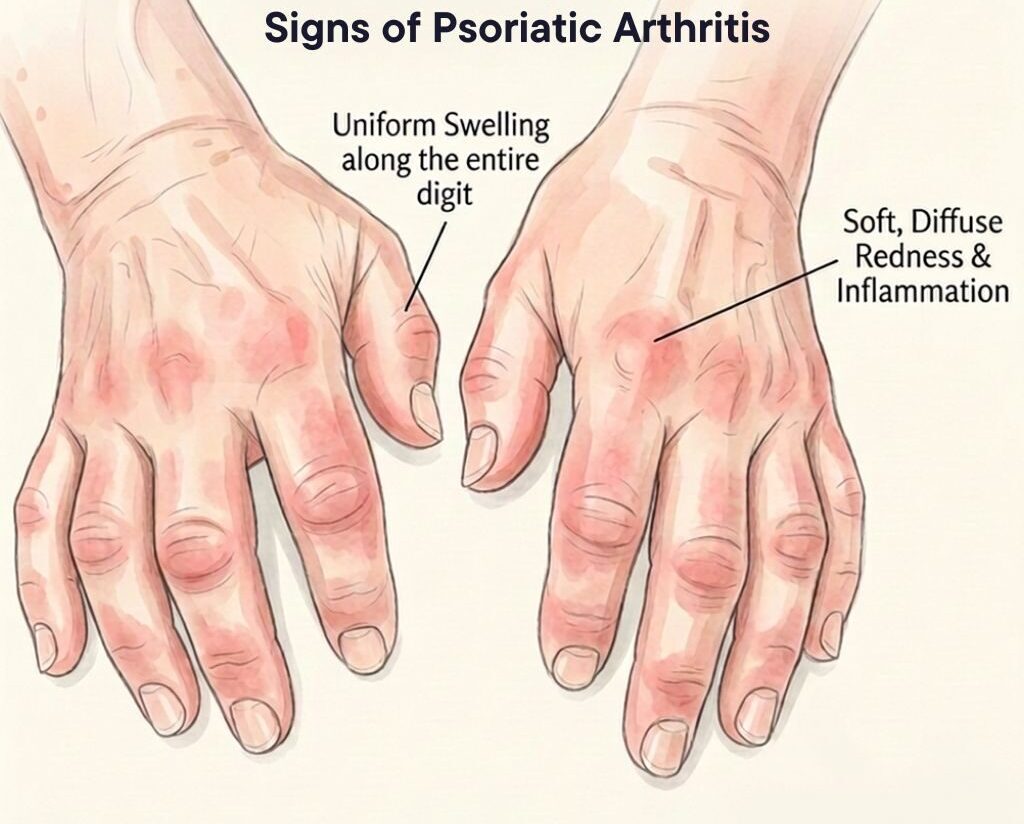
That Swollen Finger Might Not Be an Injury: It Could Be an Early Warning Sign of Psoriatic Arthritis.
Most people assume a puffy, swollen finger means they jammed it, slept on it wrong, or overdid it at the gym. But if you have psoriasis and notice that an entire finger or toe has swollen uniformly from tip to base, that is a different story entirely. That is something a rheumatologist needs to see.
The Sign Most People Miss
There is a specific type of swelling in psoriatic arthritis that looks unlike anything caused by a typical injury. The entire digit, not just a single knuckle, swells to a thick, rounded shape that rheumatologists call dactylitis. Patients and even some general practitioners frequently mistake it for a sprain, an insect bite, or simple inflammation from overuse.
What is Dactylitis
Dactylitis is caused by simultaneous inflammation in the joints and tendons running the full length of the finger or toe. It is one of the most distinctive signs of psoriatic arthritis, and it often appears years before patients receive the correct diagnosis.
August is Psoriasis Awareness Month, and this is the sign that awareness campaigns rarely talk about.
Is Psoriasis associated with arthritis
Up to 30 percent of people with psoriasis go on to develop psoriatic arthritis, often silently and gradually. The early symptoms, mild morning stiffness, occasional swelling, tendon tenderness at the heel or elbow, are easy to dismiss as normal aging or physical wear.
By the time swelling becomes obvious or pain becomes disruptive, inflammation has often been active for months or years. That matters because psoriatic arthritis causes structural joint damage that does not reverse. The window for protecting your joints is open longest at the beginning.
Most patients who arrive at OAOC with advanced psoriatic arthritis say the same thing: they noticed something earlier but assumed it was not serious enough to mention.
Why you need a rheumatologist
Dr. Arinola Dada, board-certified rheumatologist at Overlake Arthritis and Osteoporosis Center in Bellevue, WA has spent over two decades identifying the early patterns of inflammatory arthritis that other providers miss.
“Dactylitis is one of those findings that changes everything once you see it. A swollen sausage digit in a patient with psoriasis is not a mystery, it is a diagnosis waiting to be made and a joint that needs to be saved. The tragedy is how often patients are told to ice it and come back in a few weeks.“
At OAOC, patients with psoriasis and new joint symptoms receive a thorough rheumatologic evaluation that looks at the full clinical picture, skin history, joint distribution, tendon involvement, imaging, and labs, not just the symptom that brought them in.
Same-week appointments are available for patients with active swelling or pain, because early evaluation is the single most important factor in long-term outcomes.
What Should you do if you have psoriasis and Joint pains
If you have psoriasis and have noticed swelling in a finger or toe that does not look like a normal injury, do not wait for it to resolve on its own. If you have morning stiffness that takes more than 30 minutes to loosen up, pain at your heel or the bottom of your foot, or nail changes alongside joint discomfort, these are all worth a conversation with a rheumatologist now.
Take the first step to be seen at OAOC.
Get evaluated before damage becomes permanent.
The team at Overlake Arthritis and Osteoporosis Center is here to give you answers, an accurate diagnosis, and a treatment plan that protects your joints for the long term.
📞 (425) 453-0766 📧 psr@overlakearthritis.com 🌐 www.overlakearthritis.com
If you have been watching a symptom and wondering whether it is worth mentioning, it is. That call could make a decade of difference.
Have questions about psoriasis, joint pain, or psoriatic arthritis? Our rheumatology team at OAOC is here to help. Call (425) 453-0766 or email psr@overlakearthritis.com